Masked appearance
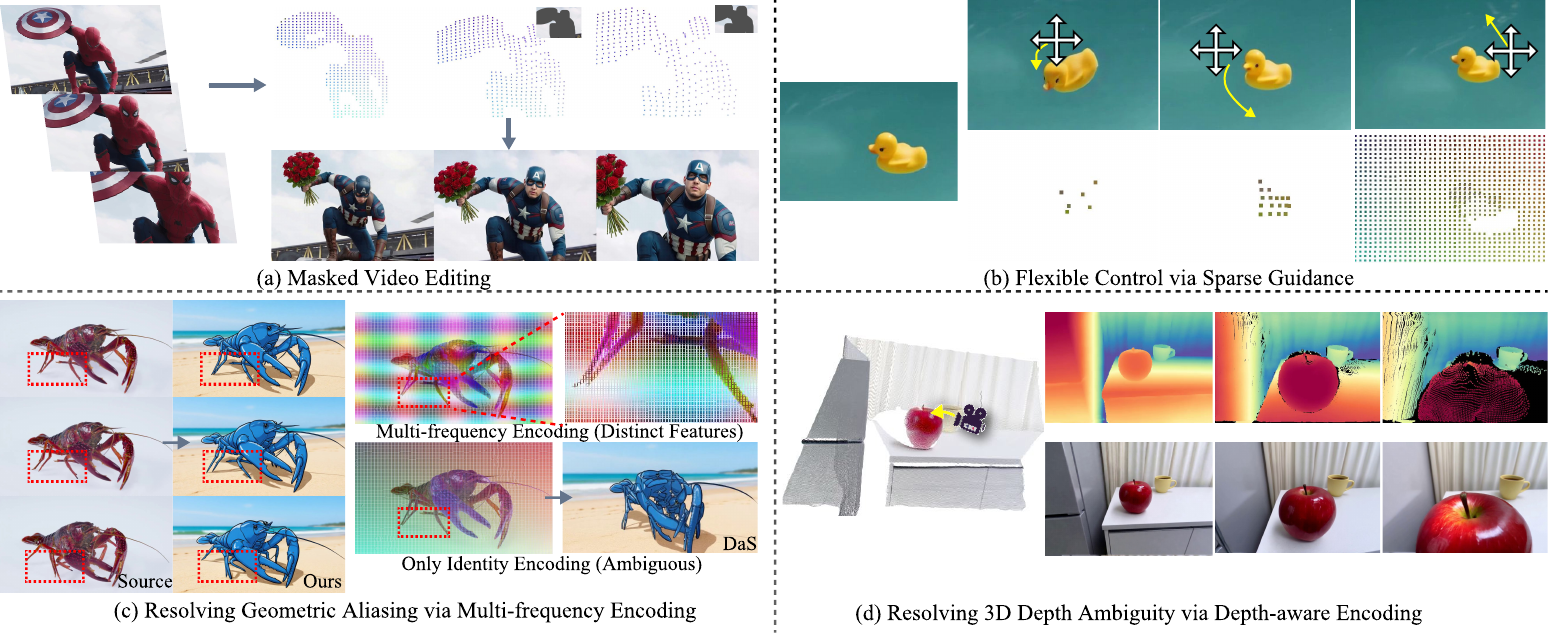
Masked video provides a unified appearance condition for flexible I2V and V2V editing beyond first-frame conditioning.
ECCV 2026
¹ HKUST (Guangzhou)² HKUST³ Macau University of Science and Technology⁴ Tsinghua University
Overview
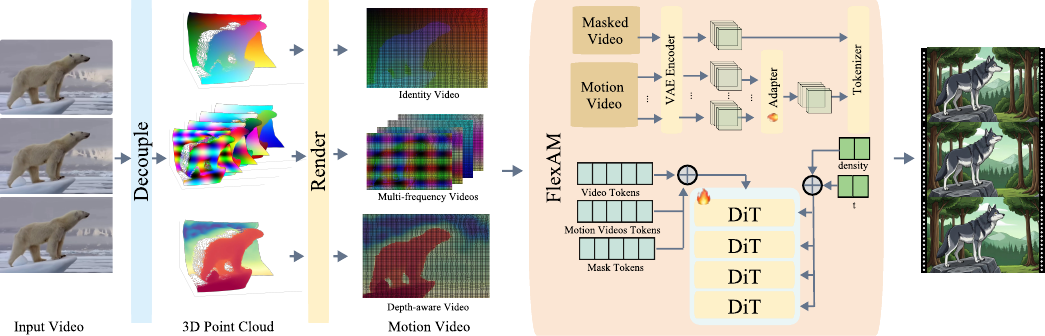
Effective and generalizable control in video generation remains a significant challenge. While many methods rely on ambiguous or task-specific signals, we argue that a fundamental disentanglement of "appearance" and "motion" provides a more robust and scalable pathway. We propose FlexAM, a unified framework built upon a novel 3D control signal. This signal represents video dynamics as a point cloud, introducing three key enhancements: multi-frequency positional encoding to distinguish fine-grained motion, depth-aware encoding, and a flexible control signal for balancing precision and generalization. This representation allows FlexAM to effectively disentangle appearance and motion, enabling a wide range of tasks including I2V/V2V editing, camera control, and spatial object editing. Extensive experiments demonstrate that FlexAM achieves superior performance across all evaluated tasks.
Method
Masked video provides a unified appearance condition for flexible I2V and V2V editing beyond first-frame conditioning.
An 18-channel motion video represents 3D point trajectories with identity, multi-frequency positional, and depth-aware encodings.
Varying point densities enable FlexAM to balance control precision and generalization across different tasks.
Results
Reference
@misc{sheng2026flexam,
  title={FlexAM: Flexible Appearance-Motion Decomposition for
         Versatile Video Generation Control},
  author={Sheng, Mingzhi and Gu, Zekai and Li, Peng and
          Lin, Cheng and Guo, Hao-Xiang and Chen, Ying-Cong and Liu, Yuan},
  year={2026},
  eprint={2602.13185},
  archivePrefix={arXiv},
  primaryClass={cs.CV}
}This work is partially supported by the Research Travel Grant of the Base of Red Bird MPhil (RBM) at The Hong Kong University of Science and Technology (Guangzhou). We would like to thank our RBM Project Supervisor Tongge Huang for the academic support.